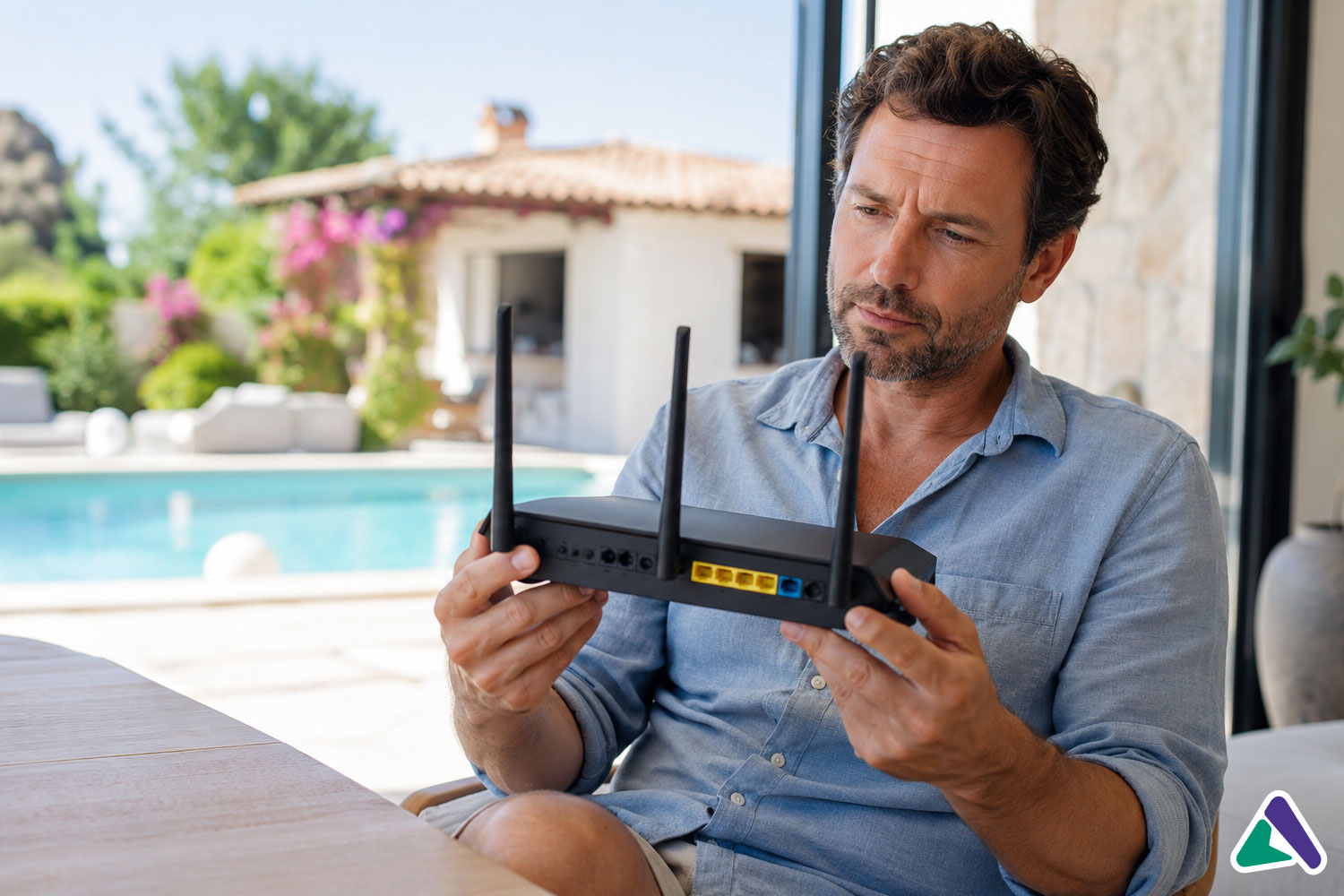




The internet for students has become something so essential for starting the school year as getting the books, the computer or the school bag.
Searching for information, handing in assignments, accessing educational platforms, downloading documents, watching online lessons or making video calls are all part of many students’ daily routine.
The problem arises when all these uses coincide.
One computer connected to an online lesson. Another downloading files. Someone watching a TV series in the living room. Two mobile phones using the Wi-Fi.
And then the phrase appears:
“What’s wrong with the internet today?”
Perhaps there’s nothing wrong with it. Perhaps you’ve simply changed the way you use the connection at home.
🎒 Studying no longer just means opening a book
Computers and internet connections have become commonplace tools for studying.
From primary school right through to university or vocational training, a large proportion of educational resources are available online.
A student may need the internet to:
- access the online campus;
- Download notes
- access educational resources;
- submit assignments;
- realizar videollamadas;
- watch videos;
- use cloud-based tools;
- work on shared documents.
That is why, when we talk about internet for students, we shouldn’t focus solely on speed.
Stability matters too.
📶 How many megabytes does a student need?
It’s probably one of the first questions that springs to mind when we’re looking for a connection.
But there’s something else we should do first:
How many people use the internet at the same time at home?
It is not the same thing as a home in which a person uses a computer as a family with four mobile phones, two computers, one games console and one Smart TV all connected.
Furthermore, many of these devices operate simultaneously.
That is why the internet connection must be assessed taking into account the combined usage of the entire property, and not just the needs of a single student.
💻 Video calls require stability
A video call is one of those moments when we quickly realise if something isn’t working properly.
The picture freezes.
The sound is delayed.
The call is cut off.
Or the dreaded phrase appears:
“We can’t hear you.”
During a lesson, tutorial or group work, these interruptions can be particularly disruptive.
A stable connection helps ensure that video calls work properly, even when other devices are using the internet at home.
📍 Where you study matters too
Sometimes we blame directly our data plan when the real problem lies with the coverage WiFi.
Imagine that the router is in the living room and the room where you study is at the other end of the house.
Between them there is a corridor, several walls and quite a distance.
The signal may be much weaker.
Before switching to a different tariff, check how the connection performs near the router and compare it with the room where you usually study.
If there is a significant difference, you probably have a problem with coverage inside your home.
📚 A house with several students requires planning
The situation gets a bit more complicated when siblings are studying at the same time.
One person might be on a video call whilst another is browsing online content and someone else is using an educational platform.
On top of that, there are the other appliances in the home.
That’s why it’s worth thinking about the connection as a service for the whole family.
A good home network should allow several people to use the internet at the same time without anyone having to shout from their bedroom:
“Stop using the Wi-Fi!”
📱 Mobile phones are also part of the course
Not everything happens on the computer.
Smartphones are used to check emails, communicate with colleagues, check timetables, access platforms or search for information quickly.
That’s why it’s also worth reviewing your mobile phone tariff at the start of the academic year.
If a student spends many hours away from home, at university or travelling, having enough mobile data can be particularly useful.
Fibre and mobile are part of the same digital ecosystem.
🌄 What if you studied from a country house?
Here in the Axarquía, we are all too familiar with this situation.
Not everyone lives in the centre of a town or in an area covered by fibre-optic broadband.
Some students live in country houses, farmhouses, rural cottages and scattered settlements.
And they need exactly the same things as any other student: to access study materials, hand in assignments, make video calls or get in touch with teachers.
For situations like these, there are solutions such as our Rural Internet, designed to provide connectivity in areas where fibre is not available.
Living far from the city centre shouldn’t mean being at a disadvantage when it comes to studying.
🔐 A good connection should also be used wisely
The start of the new school year is also a good time to talk about digital habits.
It is a good idea to teach young people to:
- use strong passwords;
- be wary of suspicious links;
- do not share personal information unnecessarily;
- keep the devices up to date;
- use the internet responsibly.
Because having a good internet connection is important.
Knowing how to use it, too.
🟣 Start the new term with everything sorted
Compramos material, organizamos horarios y preparamos el lugar donde vamos a estudiar.
But we rarely check the Internet until it starts to malfunction.
September is a good time to check whether your home internet connection still meets your family’s needs.
If you’re looking for internet for students, at Axarfusión we can help you find a suitable option, whether you have fibre broadband or need rural internet.
The course will have enough exams as it is.
Let the connection not be another.